
How to make the most of your dining experience
If you’re a self-proclaimed foodie like me, eating is one of your favorite parts of the day. But if you’re also a busy college student like me, you have the tendency to swap balanced meals for granola bars and to forgo your fruits and veggies.
In the past, I’ve written about tending to your well-being through counseling, and healthy eating is also an important form of self-care. This blog highlights existing nutrition-related resources offered by UC Berkeley, as well as professional and student advice on finding delicious meals that meet your needs. My hope is that it will help you make the most of your dining experience.
Use campus resources like the Berkeley Dining website
It wasn’t until researching for this article that I learned Berkeley Dining offers a wealth of resources related to nutrition and well-being. These include articles on food messaging online, easy recipes for students with and without kitchens, and advice on managing allergies (which we’ll add on to later in this article!).
One resource I’ve been using regularly is their macaroni and cheese microwave mug recipe. It’s cheap, quick, and delicious, and I like to spruce it up with paprika and nutmeg. If I’m feeling like I need a bit more food, I’ll add in bacon bits and steam broccoli in the microwave to have on the side.
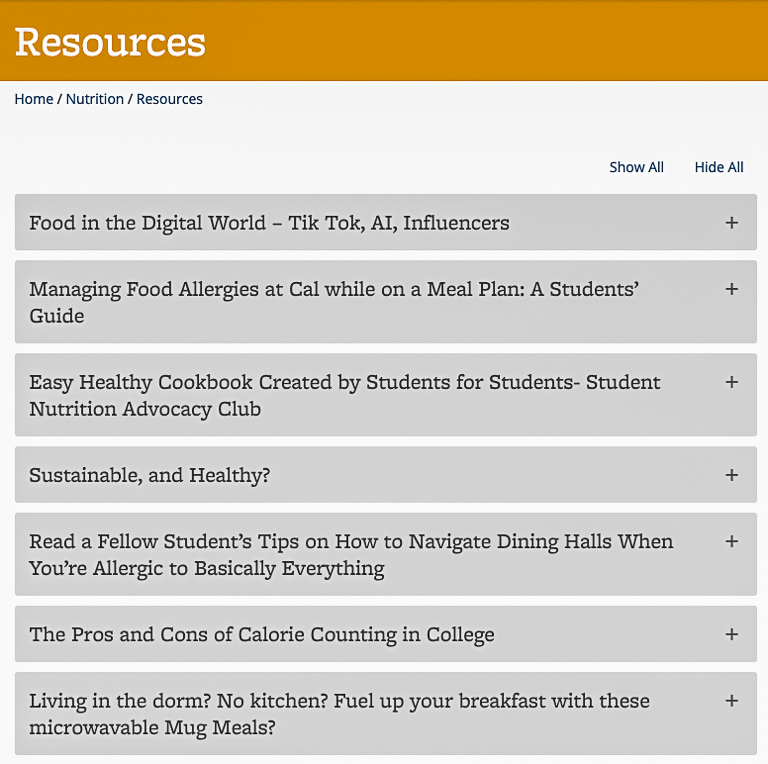
The Berkeley Dining website offers a plethora of resources.
Meet with a dietitian
Did you know that Berkeley Dining has its very own dietitian? Jaylene Tang’s role is multifaceted, but some of her responsibilities include advocating for students with specific dietary needs, screening ingredients and engineering menus for the dining commons, and overseeing dietetic interns from campus. Anyone in the Cal community with a Berkeley email address can book an appointment to connect with Jaylene at the weekly virtual Meet the Dietitian event.

Jaylene is a Registered Dietitian Nutritionist with Berkeley Dining.
I met with Jaylene a few weeks ago to ask about Berkeley Dining’s sustainability efforts and some of her personal advice when it comes to meals.
What does sustainability look like in the dining commons?
“Berkeley Dining’s sustainability efforts are managed by the Housing and Dining Sustainability team. Our notable sustainability practices include:
- Sustainable food sourcing – prioritize ingredients from producers that practice environmental and social responsibility.
- Plant-forward menu – ensure there is a variety of plant-based protein options at any given meal and encourage plant-based culinary creativity through the ongoing plant-forward challenge.
- Food waste reduction – primarily by minimizing the use of disposables as much as possible, and by encouraging customers to take only what they will eat in our all-you-care-to-eat dining commons.
- Food donation – regularly donate overproduced food to the campus food pantry and local nonprofits.”
Do you have any advice for picky eaters like myself?
“Start with knowing yourself. Have a list of safe foods, including texture or cooking methods you enjoy. Categorize this safe food list by putting the items in the major food groups (protein, carbohydrates, fruits and veggies). Slowly add one new food at a time alongside your safe foods. While doing so, try your best to have balanced meals that include all major food groups, this will ensure adequate nutrient intake per meal. If you’re in the dining commons, take advantage of the customizable platforms (e.g. salad bar, grain bowls, sandwiches). That way, you have more control of ingredients.
Finally, don’t pressure yourself to like something. Just keep trying new foods in small amounts. And remember: Your taste buds do change!”

Some of Jaylene’s colorful and nutritious meals.
What’s a food you think all students should eat more of?
“In the dining commons, I’d say a bowl of salad from the salad bar, ideally with a colorful combo of veggies, topped with choices of protein and dressed with olive oil and vinegar. The salad bar is readily available, accessible, customizable, and nearly guaranteed nutritious!”
Manage your allergies
Having specific dietary needs, such as severe food allergies, can make managing your meals more difficult. So, what support does Berkeley offer to make your life easier? Hannah, a student with severe food allergies, offers a student perspective on this topic, alongside advice from Berkeley Dining’s dietitian.
Apply for housing accommodations: “Consider reaching out to student housing. Our first year, my two roommates and I lived in a Unit 1 triple room, which typically comes with one refrigerator and microwave. I was able to get an extra refrigerator and microwave unit to avoid cross-contact concerns.” — Hannah, Class of 2026, art practice & media studies major
Use the allergen and gluten-friendly Section: “All Dining Commons have a dedicated allergen and gluten-friendly station serving lunch/brunch and dinner 7 days a week with a menu free of all Top-9 food allergens and gluten-containing ingredients. This station always offers a complete meal with at least one gluten-free starch, one cooked vegetable, one plant-based, and one animal protein option, and gluten-free breads and desserts available upon request.
The allergen-friendly station in each dining hall has a varied level of separation from the main kitchens, depending on the space and equipment constraints. The Allergen-Friendly Station at Crossroads (and Foothill, once the renovation is complete) has dedicated ovens and is more separated by physical space, too.” — Jaylene Tang, MS. RDN

Meals from the allergen-friendly section.
Watch for cross-contact: “Shared spaces can be dangerous, as it’s easy for adjacent serving trays to spill into each other. For example, the sandwich stations might seem safe, but cheese or dressings, which I have an anaphylactic response to, can easily spill onto the vegetables. Also, when returning your tray and dishes, be careful not to touch the station itself! Try to look for an opening on the rack, and be mindful of spills or even invisible contamination. Err on the side of caution!” — Hannah, Class of 2026, art practice & media studies major
Take advantage of your flex and flex+ dollars: “The Flex Dollars in your Berkeley Dining meal plan can be used to purchase commercial frozen meals, snacks, and beverages, as well as non-food items in our convenience stores. Flex+ Dollars can also be used on Grubhub to order pick-up and delivery from over 1,000 local restaurants.” — Jaylene Tang, MS. RDN
Be vigilant: “Don’t be afraid to ask if you have any concerns about a specific food item or potential cross-contact. It’s always better to be safe than sorry. You might also want to supplement meals from the dining commons with food that you prepare yourself or buy, maybe even using your Flex Dollars. Remember: You know your needs better than anyone else.” — Hannah, Class of 2026, art practice & media studies major
Try home cooking
Having a meal plan eliminates some of the time and stress associated with mealtimes, but it’s never a bad idea to pursue home cooking — whether that be in the shared kitchen of your residence hall or your off-campus apartment. Cooking for yourself means you have more control over what you eat, when you eat, and how much you spend on food each week.
I’m on campus from 10 a.m. to 9 p.m. several days a week, so I’m a big fan of prepping my lunches and dinners. I plan the following week’s meals on Wednesday, grocery shop on Thursday, and then cook on Sunday or Monday. I can then bring what I prepared as a bento on Tuesday, Wednesday, and Thursday. Because I end up eating the same thing multiple days in a row, I rely on comfort foods I know I won’t get sick of like Japanese curry.
If you’re trying not to break the bank when it comes to grocery shopping, try these three tips:
- Keep your eyes peeled for coupons, especially on the internet. There are some apps that can help with locating discounts.
- Always utilize your student discount at applicable stores, such as Safeway. It never hurts to do a quick search before you head out to a new grocery store.
- Check your eligibility for CalFresh, a federally funded program that provides eligible individuals with up to $292 toward groceries per month. I received CalFresh my sophomore year, and it greatly reduced my stress and the financial burden placed on my family.

Happy (and healthy) eating!
I hope this article gave you some insight into how to make the most of your meals at UC Berkeley, whether you have a meal plan or not. It’s easy to get caught up in academics and extracurriculars, especially around midterms and finals, but your health and well-being should come first. Prioritize them and enjoy your meals!
Be well, Golden Bears.
Nina Takahashi, Class of 2026, is majoring in film & media and minoring in Japanese & creative writing. Cover photo by Jennifer Santos Denton.
Want More?
- What goes into curating a sustainable and delicious meal? Learn how one dish travels from farm to belly.
- Discover the best spots to eat outside on campus.
- Make the most of your UC Berkeley Dining meal plan and explore the Student Union building’s eateries.