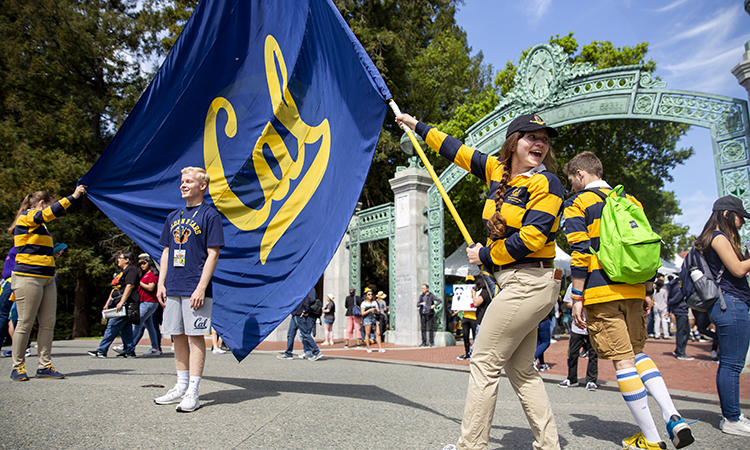
Learning the Berkeley lingo.
Croads. EECS. And, my personal favorite, Berkeley Time. As a new student, understanding all of UC Berkeley’s unique lingo from the get-go can be difficult. Luckily, UC Berkeley Life has you covered. Instead of having to guess what every acronym or phrase might mean, we’ve compiled a list of some of the most common ones you’ll hear around campus. Keep reading to check how many you know.
Berkeleyisms
ASUC: “ASUC” stands for the Associated Students of the University of California and is the officially recognized student association at UC Berkeley.
bCourses: “bCourses” is an online platform that most classes use to post assignments and relevant materials. It’s our campus-specific version of Canvas, a learning management system like Google Classroom.
Berkeley time: Almost all events on the UC Berkeley campus, like lectures and club meetings, start at “Berkeley time,” which is 10 minutes after the hour. So, if you have a lecture at 9 a.m., it actually starts at 9:10 a.m. This guideline is put in place so you can schedule classes and meetings back to back without being late. When it comes to being a busy Berkeley student, it is definitely a saving grace and helps you plan more in your schedule.
Note: Be sure to double check that your final exams and other important events start at Berkeley Time. Some professors and schedulers don’t follow this extra 10-minute guideline as strictly.
“Berkeley Time” can also refer to the online platform Berkeleytime, which is a resource that many students use to determine which classes they’d like to take. Berkeleytime allows you to view grade distributions for certain courses, along with other helpful information from students.
Cal: “Cal,” short for California, is the university’s iconic athletics brand that generates pride and passion among legions of sports fans. Apart from scoring victories in national sports arenas, Cal’s student athletes consistently bring home Olympic medals: 21 from the 2016 Rio Olympics, 16 from the 2020 Tokyo Olympics, and 23 from the 2024 Paris Summer Olympics.
Cal is also used as a term of endearment and pride for the university, especially by alumni and students. The University got this nickname because we were the first university in the UC system.
Calapalooza: “Calapalooza” is an event that occurs at the start of every semester. For one afternoon, you will find Upper Sproul filled with displays from the many student organizations and clubs that Berkeley has to offer, with the goal of advertising to potential new members. From club sports to pre-professional clubs to arts-focused organizations, the options are endless! Calapalooza is a great time to learn more about different clubs, find what piques your interest, and join a new student group.
CalCentral: “CalCentral” is the main website that Berkeley students use to track their financial aid and loans, units and degree progress, and anything administrative that is tied to the university.
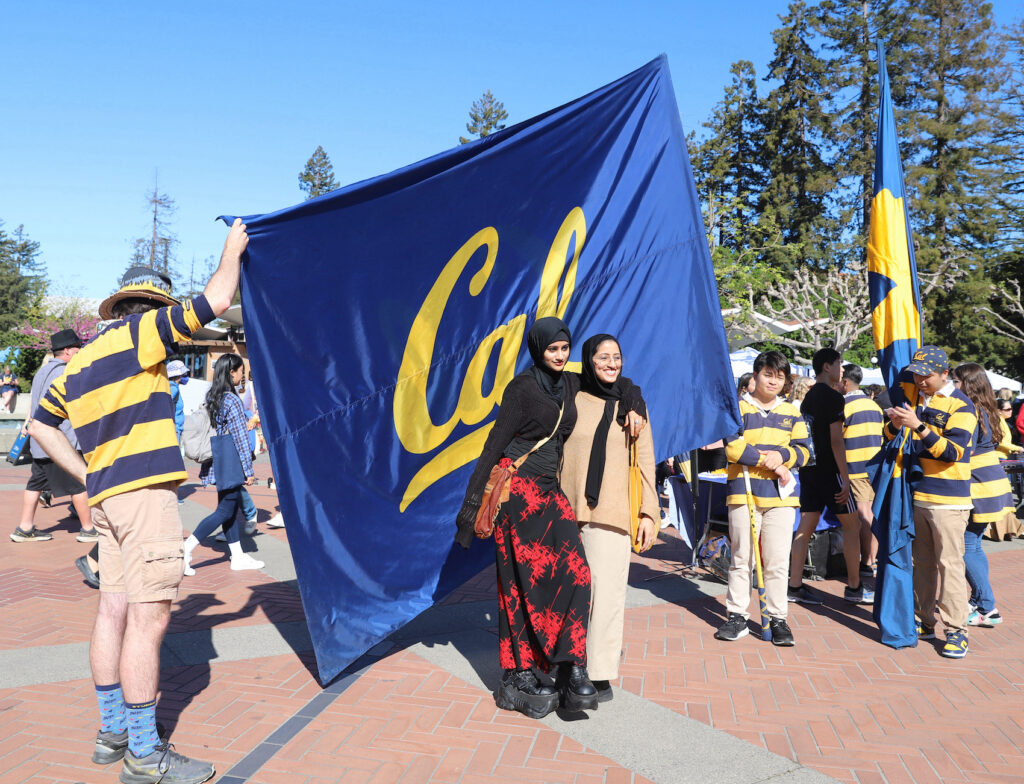
Cal Day, held each year, is when the campus is open to the public.
Cal Day: “Cal Day” is a day, usually in April, when Berkeley opens up the campus to the public and showcases events for prospective students and admitted first years. During Cal Day, each department usually holds informational events, and clubs have performances so prospective students can get a glimpse of life at Cal.
Cal Student Central: “Cal Student Central” is the office that helps students navigate several student-facing departments at Berkeley — not to be confused with the website CalCentral. Located here are the Financial Aid and Scholarships Office, Office of the Registrar, Accounts Payable, and Billing and Payment Services. The office is located in Sproul Hall, which is the main building up the Sproul Plaza-facing steps.
Croads: “Croads” is a nickname for Berkeley Dining’s Crossroads, which is one of the main dining commons near campus by Unit 2.
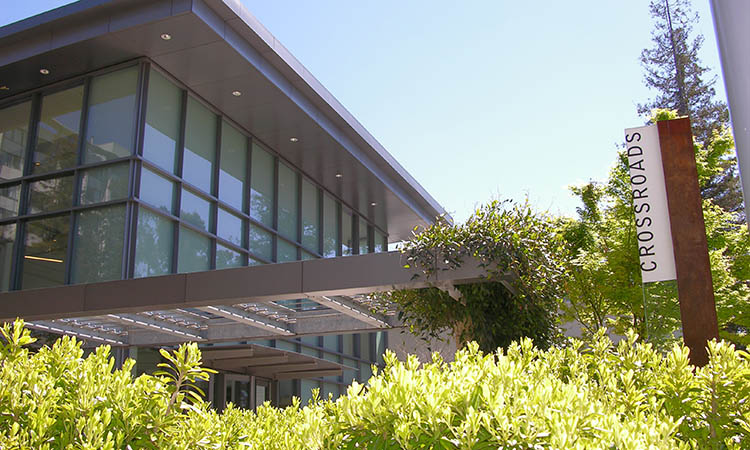
Croads or Crossroads, the dining commons at the corner of Bowditch and Channing Way.
EECS: “EECS” (pronounced EEKS) stands for Electrical Engineering and Computer Science majors. During your time at Berkeley, you’re bound to meet a ton of EECS majors, so it’s helpful to know the acronym right away.
Fiat Lux: “Fiat Lux” is Latin for “Let there be light,” which is UC Berkeley’s official motto. You will find these words on various university signage or materials, including our school’s seal.
MCB: Molecular and cell biology (MCB) is another one of the most common majors at Cal. Memorizing this acronym is a good idea.
GBO: “GBO” is an acronym for Golden Bear Orientation, an activity-filled, introductory week intended to help incoming UC Berkeley students transition into their lives here at Cal. It allows you to sample the dining commons, attend some of your first campus-hosted events, and learn how to use the local transit systems, not to mention meet fellow new Golden Bears!
FSM: “FSM” stands for the “Free Speech Movement” which started in Berkeley with a group of college students who, during the 1960s, challenged campus regulations limiting their free speech rights. Named after the “FSM” is the Free Speech Movement Café, conveniently attached to Moffitt, one of the main libraries here on campus.
GSI: A “GSI” is a graduate student instructor who usually leads the discussion sections for classes, holds office hours so you can ask questions about course content, and grades assignments and papers.
I-House: International House, or “I-House” for short, is a multicultural residential living and learning center of nearly 600 students and scholars from 70+ countries, including the U.S. Their mission is to foster intercultural respect and understanding, lifelong friendships, and leadership skills for a more peaceful world.
Upper Sproul: One of the main sections on the south side of campus is Sproul Plaza, or “Upper Sproul,” located near Sather Gate. This is where you’ll usually find clubs tabling.
Lower Sproul: “Lower Sproul” is located near Zellerbach Hall, home of Cal Performances, down the staircase that is attached to Upper Sproul.
Tabling: On Sproul, clubs hand out flyers or have fundraisers to promote themselves, which is commonly referred to as “tabling.”
L&S: “L&S” is an acronym for the College of Letters & Science, the largest college at UC Berkeley. The majors in L&S bridge the arts and humanities, social sciences, and natural sciences, with majors ranging from English to physics. L&S has different requirements to graduate compared to other colleges, such as the College of Engineering, so make sure you plan your four-year class schedule accordingly if you’re an L&S student.

Some of the many study spaces that Main Stacks offers. Photo courtesy of Steve McConnell/UC Berkeley PA.
Main Stacks: “Main Stacks” is the commonly used term for the David Pierpont Gardner Stacks, home to Doe Library’s research collection. Here, you will find shelves upon shelves of books, abundant study spaces, and multiple private study rooms available for reservations, extending four floors underground. Many students appreciate Main Stacks for its extremely silent environment, making it the optimal place to “lock in.”
MLK: At Berkeley, “MLK” usually stands for the Martin Luther King Jr. Building located on the edge of campus near Sproul. MLK houses the Student Union, eateries, the Student Store, and an Amazon Hub Locker, among other important spots.
Berkeley’s mascot is named after the old “Oski Yell” that was recited at almost every football and basketball game in the early 1900s.
Oski: “Oski” is Berkeley’s pride and joy and the best college mascot we could have! If you happen to see him at any sports event or even on Sproul, you should definitely take a picture with him.
RecWell: “RecWell” is the abbreviation for UC Berkeley Recreation & Wellbeing, which provides diverse and inclusive services and facilities to Berkeley students, staff, and faculty. Offering programs like intramural sports, Esports, and nutrition seminars, RecWell supports Cal community members with their physical and mental health.
RSF: The “RSF” is an acronym for the Recreational Sports Facility, which is where most students exercise. The building is located on Bancroft Way near the Haas Pavilion and boasts an impressive variety of equipment, rooms, and classes.
Res Hall: “Res Hall” is short for “residence hall,” often called dorms by students. Berkeley has eight different Res Hall locations, with varying room types available. Living in the Res Halls offers students the opportunity to connect with students in their building, participate in residence hall events, and take advantage of resources provided through UC Berkeley Housing!
SOCS: “SOCS” is the Social Sciences Building in Berkeley, located near the Hearst Gymnasium.
DeCal: A “DeCal,” or Democratic Education at Cal, course is a one- or two-unit course, entirely facilitated by students, about a topic not covered by the traditional UC Berkeley curriculum. Students often take them to explore a passion or new interest, or to reach the minimum unit requirement to be considered a full-time student.
BART: “BART” is an acronym for the Bay Area Rapid Transit System, which is now fare-free for UC Berkeley students under the 2025 BayPass Referendum. Take advantage of the BART and plan a day trip or night out to a destination like downtown Oakland or San Francisco.
SF: “SF” is an acronym for San Francisco, which is located only 30 minutes away from campus. With BayPass, you can get to SF for free.
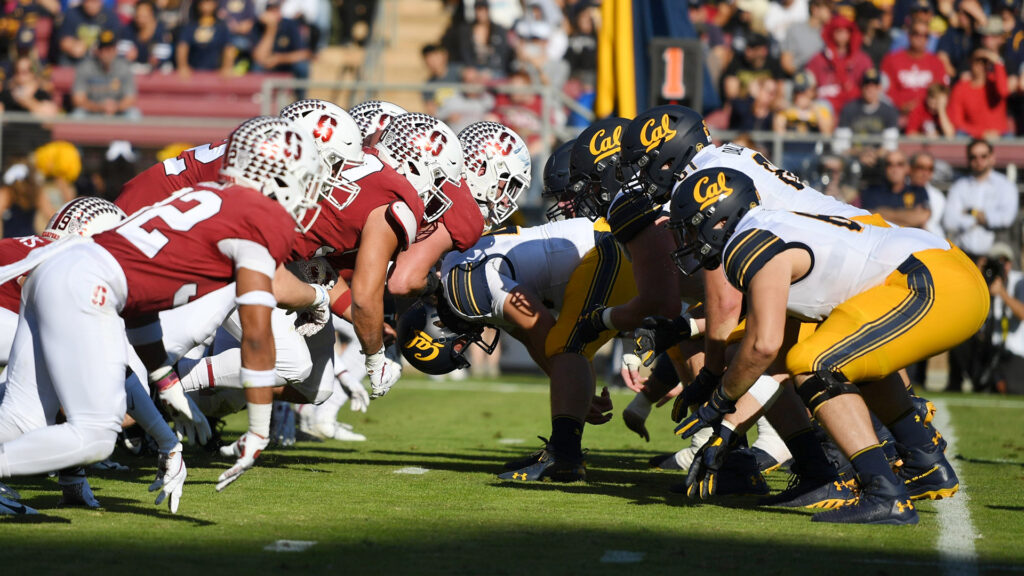
Go Bears! Be sure to save your seat at The Big Game in the fall.
The Axe: Every year, the Cal football team goes against the Stanford football team in what is referred to as “The Big Game.” Whoever wins the Big Game receives “the Axe,” a trophy of an axe head, to show off their victory. UC Berkeley was home to the Axe for four consecutive years until 2025.
The Glade: “The Glade” refers to Memorial Glade, the sprawling patch of grass outside of Doe Library. Since it is the size of a small park, many students like to relax there with friends, toss frisbees, enjoy the sun, or even lie down for a short nap.
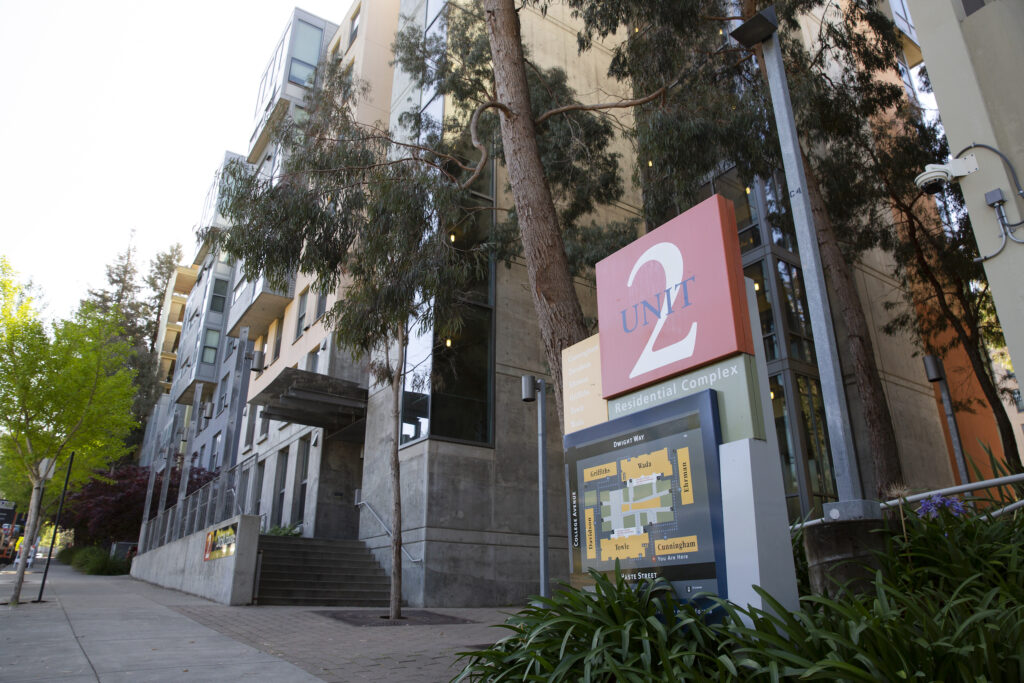
Unit 2, on Haste Street, is one of three residential halls located near campus.
The Units: The residence halls on campus are commonly nicknamed “the Units.” There are three units on campus: Unit 1, Unit 2, and Unit 3. Foothill and Clark Kerr halls are a little bit further away from campus and are sometimes referred to as Unit 4 and Unit 5.
RRR Week: Reading, Review, and Recitation Week, commonly known as “RRR week,” is the week following the end of formal class instruction and preceding the start of final exams. It’s meant to be a time for students to synthesize all of the material they’ve covered in a course.
APR: Your Academic Progress Report, or “APR,” is one component of the My Academics tab within your CalCentral. It’s how students can track their progress toward majors, minors, campus requirements, and college-specific requirements.
Esh: “Esh” is a nickname for Eshleman Hall, arguably the most misspelled building on campus. Many clubs host their meetings in Eshleman Hall, and like MLK, this building requires a Cal ID card for entry.
VLSB: “VLSB” stands for the Valley Life Sciences Building, located on Harmon Way and home to Osborn, UC Berkeley’s T. rex specimen, which is about 90% complete, only missing a few bones from the tail.
See you on Sproul!
Trends come and go, but some of this Berkeley lingo has been around for decades, if not centuries. How many of the phrases in this blog did you know? Were you 37 for 37? Or, are there new phrases you’ve started to hear popping up in your daily life at Cal? Our university’s culture and language are being shaped and reshaped every day and we’re grateful to be part of the process.
Revised and updated by Shae Cogswell, Class of 2029, majoring in English. 2025 updates by Nina Takahashi, Class of 2026, majoring in film & media and minoring in Japanese and creative writing. This article was first published in 2023 by Samantha Herrera, Class of 2023, who majored in English and minored in journalism and creative writing.
Want More?
- Check out more resources for new students.
- Read about what life in the Units (and other residence halls) is like.
- Learn about your Student Union.